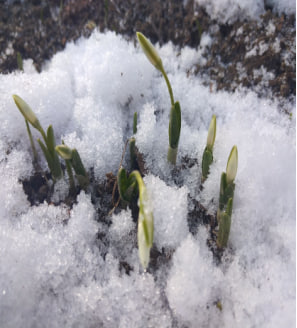
The first harbingers of spring in the Tashkent Botanical Garden: Spring exposition of the collection of ornamental grasses
The collection of ornamental grasses is a scientific and practical exposition formed for the purpose of preserving, introducing plant species, studying their bioecological characteristics, conducting phenological observations, and determining seed productivity.
Currently, the collection contains 243 species of ornamental grasses belonging to 27 families and 107 genera, on which regular phenological and bioecological studies are conducted.
The following families occupy a leading position in the collection:
Asteraceae — Aster family
Campanulaceae — Campanula family
Ranunculaceae — Aquilegia family
Scrophulariaceae — Penstemon family
Spring flowering dynamics
The spring period is of particular aesthetic and scientific importance in the collection. In late March - early April, early flowering perennial bulbous and rhizome plants enter the active period of the vegetation phase. This process is regularly recorded through phenological observations.
Especially early-flowering species in the spring exposition are distinguished by their bright colors, delicate structure and frost resistance.
Snowdrop - a symbolic plant of spring
Galanthus (Snowdrop) - a perennial bulbous plant belonging to the Amaryllidaceae family, famous for its early spring flowering. Popularly known as the "snow flower", this plant blooms as soon as the snow melts and is considered one of the first harbingers of spring.
Morphological description:
Height: 10–20 cm
Leaves: oblong, dark green or gray-green
Flower: white, bell-shaped, bent downward
Petals: 6 (3 outer large, 3 inner small)
Inner petals have green spots or stripes
Galanthus species are mainly distributed naturally in Europe, the Caucasus and Asia Minor, and some species are also found in Central Asia.
The primrose is important in landscape compositions due to its early flowering, frost resistance, and elegant appearance.
Currently, the active flowering phase of primroses is observed in the Tashkent Botanical Garden.